AI Risk Assessment Framework: A Step-by-Step Guide
Master AI risk assessment with our step-by-step framework. Identify, analyze, and mitigate AI risks across your entire organization using proven methodologies.

Key Takeaways
- An AI risk assessment framework is a structured methodology for systematically identifying, evaluating, and mitigating risks unique to artificial intelligence systems
- Five primary risk categories require attention: bias and discrimination, security vulnerabilities, privacy violations, operational failures, and compliance gaps
- The six-step process (identify, map, catalog, analyze, evaluate, monitor) transforms ad-hoc reviews into repeatable, auditable risk management
- NIST AI RMF and ISO/IEC 42001 provide complementary approaches—NIST offers flexible principles-based guidance while ISO enables formal certification
- Continuous monitoring is essential because AI systems evolve through model drift, data changes, and emerging threats
- Regulatory requirements are intensifying globally, with the EU AI Act and NIST guidance driving mandatory risk assessment practices
- Automated tools like SentinelOne's platform can transform manual framework implementation into scalable, real-time risk management
What Is an AI Risk Assessment Framework?
An AI risk assessment framework is a structured playbook that helps you catalog every AI system in your organization, identify the likelihood and impact of threats, and plan mitigations before the threats turn into a security incident. The comprehensive artificial intelligence risk assessment approach explained in this article mirrors best-practice standards like NIST AI RMF and ISO/IEC 42001:
- Identify and inventory every AI system
- Map stakeholders and impact areas
- Catalog potential risks and threats
- Analyze risk likelihood and impact
- Evaluate risk tolerance and treatment options
- Implement monitoring and continuous assessment
By following these AI risk evaluation steps, you move from reactive fire-fighting with an ad-hoc approach to a repeatable process that is measurable, auditable, and regulation-ready. A structured framework can encourage alignment across governance, security, data science, and legal when prioritizing high-impact issues.
What AI Risk Assessment Challenges Do Organizations Face?
Rule-based IT is predictable. Artificial intelligence is not. Machine learning systems introduce new categories of risk that traditional IT never faced.
The Expanding AI Security Risk Assessment Landscape
Five categories show how these threats differ from traditional IT risks and require specialized ai risk evaluation approaches:
- Bias and discrimination occur when training data preserves historical prejudice. Facial recognition systems misidentify people of color at rates far higher than white subjects, leading to wrongful arrests and denied services. The training and use of AI models calls for an increased awareness of bias and discrimination compared to traditional IT considerations.
- Security vulnerabilities emerge when adversaries use model inversion or prompt injection attacks to extract private training data or force toxic outputs. These attacks target the model itself, not just the surrounding infrastructure, creating an entirely new attack surface.
- Privacy violations multiply as large language models consume vast data sets. Without strict controls, sensitive content from internal documents can appear in public-facing AI content, creating instant compliance violations.
- Operational failures develop faster and further than typical software bugs. An autonomous vehicle's fatal braking delay or a supply chain forecast that swings procurement by millions demonstrates how machine learning mistakes cascade through business-critical processes.
- Compliance challenges intensify as regulations demand documented risk assessments, human oversight, and continuous monitoring for high-risk systems. Traditional IT rarely faces this depth of legally mandated, model-level scrutiny.
Industry Impact Varies Significantly
AI presents unique security considerations depending on the industry:
- Manufacturing faces workforce and reputational risks from AI-powered automation.
- Financial institutions wrestle with algorithmic credit scoring that can entrench bias while regulators demand explainability.
- Healthcare organizations face diagnostic models that may misclassify rare diseases.
- Public sector automated benefit decisions threaten civil rights obligations.
Understanding the new risks introduced by AI and accounting for industry-specific considerations is your first step toward building comprehensive AI risk assessment frameworks that satisfy regulators and protect the people depending on your systems.
Common AI Risk Categories
Understanding the primary categories of AI risk is essential for comprehensive assessment:
- Bias and discrimination: Systematic unfairness in AI outputs caused by skewed training data or flawed model design
- Security vulnerabilities: Attack surfaces unique to AI systems, including adversarial inputs, model extraction, and data poisoning
- Privacy violations: Unauthorized exposure of sensitive information through model outputs or training data leakage
- Operational failures: Model errors, performance degradation, or unexpected behaviors that disrupt business processes
- Compliance gaps: Failure to meet regulatory requirements for transparency, documentation, human oversight, or risk management
Why Structured AI Risk Assessment Frameworks Matter
Ad-hoc checklists and scattered security reviews do not work for AI systems. Unlike traditional IT, these technologies introduce opaque decision logic, evolving models, and entirely new failure modes.
Without a structured artificial intelligence risk assessment framework, you discover risks piecemeal, apply controls inconsistently, and rarely capture lessons for future projects. This creates blind spots that expand with every new model deployment and compromise your AI security risk assessment efforts.
Regulatory Pressure Drives Adoption
Regulators are not waiting for organizations to catch up. Every major jurisdiction expects you to know where your models live, how they behave, and how their risks are controlled.
The EU formalized a tiered, risk-based regime through legislation. U.S. agencies push voluntary but increasingly enforced guidance like the NIST AI RMF. Japan's AI Promotion Act and Australia's principle-led standards show that even innovation-first jurisdictions expect disciplined risk management as AI use increases.
Framework Benefits for Organizations
A standardized AI risk analysis framework delivers four concrete advantages:
- Repeatability ensures uniform AI risk evaluation steps and metrics provide consistent vetting from pilot to production.
- Audit readiness means that documented risk registers and mitigation logs satisfy reviewers.
- Cross-team alignment happens when shared taxonomies keep security, data science, and legal teams synchronized on AI security risk assessment priorities.
- Regulatory mapping allows controls to trace directly to regional obligations, simplifying multi-jurisdiction compliance.
Core Components of Effective AI Risk Assessment Frameworks
Before you dive into the six-step AI risk evaluation process, it helps to see the moving parts of any reliable analysis framework.
Essential Framework Elements
Every mature artificial intelligence risk assessment model answers five technical questions: How will you discover systems, rate their danger, decide which issues to tackle first, design treatments, and monitor conditions as they evolve?
These questions can be approached through specific elements in the risk evaluation process:
- Identification inventories every model, production, or shadow so nothing slips through governance nets.
- Risk scoring translates concerns into comparable numbers or tiers, combining qualitative ratings with quantitative outputs like failure probability or expected loss.
- Prioritization channels scarce budget toward scenarios where high likelihood meets high impact.
- Treatment planning matches each priority to concrete actions like mitigate, transfer, accept, or avoid.
- Continuous monitoring tracks model drift, bias re-emergence, and control effectiveness in real time.
Aligning the Framework to Current Standards
The NIST AI Risk Management Framework aligns with these needs through four iterative pillars:
- Map: guides system identification.
- Measure: underpins scoring.
- Manage: drives treatment and monitoring.
- Govern: embeds accountability and policy across each stage, ensuring board-level visibility and resources.
ISO/IEC 42001 layers the same concepts onto the familiar Plan-Do-Check-Act cycle:
- Plan: handles identification and scoring.
- Do: manages control implementation.
- Check: reviews performance data.
- Act: closes the loop with improvements.
Effective cloud security governance requires this same structured approach to risk management across distributed environments.
NIST AI RMF vs. ISO/IEC 42001 Comparison
Aspect | NIST AI RMF | ISO/IEC 42001 |
Core Phases | Map, Measure, Manage, Govern | Plan, Do, Check, Act |
Primary Focus | Risk identification and continuous management | Management system certification and process standardization |
Compliance Applicability | U.S. federal agencies; voluntary for private sector | International certification standard; auditable compliance |
Ideal Use Cases | Organizations seeking flexible, principles-based guidance; U.S. regulatory alignment | Organizations requiring formal certification; multinational compliance needs |
Effective cloud security governance requires this same structured approach to risk management across distributed environments.
Step-by-Step AI Risk Analysis Framework Process
A structured AI security risk assessment approach creates a systematic framework that identifies real threats and keeps them controlled. This six-step artificial intelligence risk assessment process follows the NIST "Map-Measure-Manage" cycle while staying practical for your security team.
Step 1: Identify and Inventory AI Systems
Find every model, pipeline, or script in your environment, including shadow projects your data scientists built on personal credit cards. Surveys and stakeholder interviews catch the obvious uses, but automated discovery does the heavy lifting.
AI inventory management tools can scan code repositories for TensorFlow or PyTorch imports, track cloud billing for GPU spikes, and analyze commit messages to reveal hidden workstreams.
Feed every discovery into a living system register that captures owner, purpose, data sources, and deployment environment.
Classify each system by inherent risk level. Chat-ops bots rate as "low" while credit-scoring models rate as "high." This classification drives how much scrutiny and control each model receives.
Step 2: Map Stakeholders and Impact Areas
Every system affects more people than you expect. Identify builders, operators, legal counsel, compliance officers, and end users. Document their roles in a RACI matrix to clarify how each person interacts with the AI systems under consideration.
Map impact areas including revenue, customer experience, brand reputation, safety, and regulatory exposure. Understanding these dependencies can prevent late-stage surprises when a model tweak triggers privacy reviews or customer escalations.
Step 3: Catalog Potential Risks and Threats
Consistently document each threat with a description, triggering conditions, existing controls, and potential consequences.
Run focused risk-identification workshops combining category approaches with scenario brainstorming. Consider security, privacy, and operational risks systematically in your AI risk evaluation process. Ask "What if adversaries poison training data?" or "What if the model discriminates against protected classes?" Bias deserves dedicated attention. Diverse training data prevents discrimination from being hard-coded into systems.
Security vulnerabilities can emerge when adversaries use model inversion or prompt injection attacks to extract private training data or force toxic outputs. Modern AI vulnerability management requires continuous monitoring of these attack surfaces alongside traditional infrastructure threats in your AI security risk assessment program.
Step 4: Analyze Risk Likelihood and Impact
Use qualitative and quantitative insights to place each threat on a simple AI risk assessment matrix. When ranking, blend qualitative insights from subject matter experts with quantitative metrics like historical incident rates or predicted financial loss.
Plot threats based on two factors:
- Likelihood: graded from rare to almost certain.
- Severity: ranging from negligible to severe.
Prioritize addressing threats that are classified as “almost certain” and “severe”.
This approach catches both obvious technical risks and softer issues like explainability gaps.
Step 5: Evaluate Risk Tolerance and Treatment Options
Compare each risk to your organization's risk tolerance. If residual scores sit below tolerance, accept them. Otherwise, choose to mitigate, transfer, or avoid the risk entirely.
Mitigation often means technical controls like bias algorithms, adversarial-robust training, or human-in-the-loop overrides. Process controls include enhanced audit logging and approval workflows. High-risk generative models might get sandboxed or pulled from production until guardrails are ready.
Step 6: Implement Monitoring and Continuous Assessment
Your AI risk assessment framework must continue to evolve with the ongoing changes to machine learning and AI tools. Track Key Risk Indicators like model drift rate, false positive ratio, or GPU utilization spikes in your ongoing AI risk evaluation process. When metrics breach thresholds, trigger re-assessment and loop back to Step 3.
Apply lessons learned from incident reviews into your risk framework to ensure it evolves with your use of AI. Cycling through these six steps transforms risk management from one-off audits into an ongoing practice to keep pace with changing regulation and AI innovations.
SentinelOne and AI Risk Assessment Frameworks
SentinelOne's Singularity Platform transforms traditional AI risk assessment frameworks from manual documentation into automated, continuous monitoring that scales with your AI portfolio. The platform addresses critical gaps in conventional artificial intelligence risk assessment approaches by providing real-time visibility into AI systems and their associated threats.
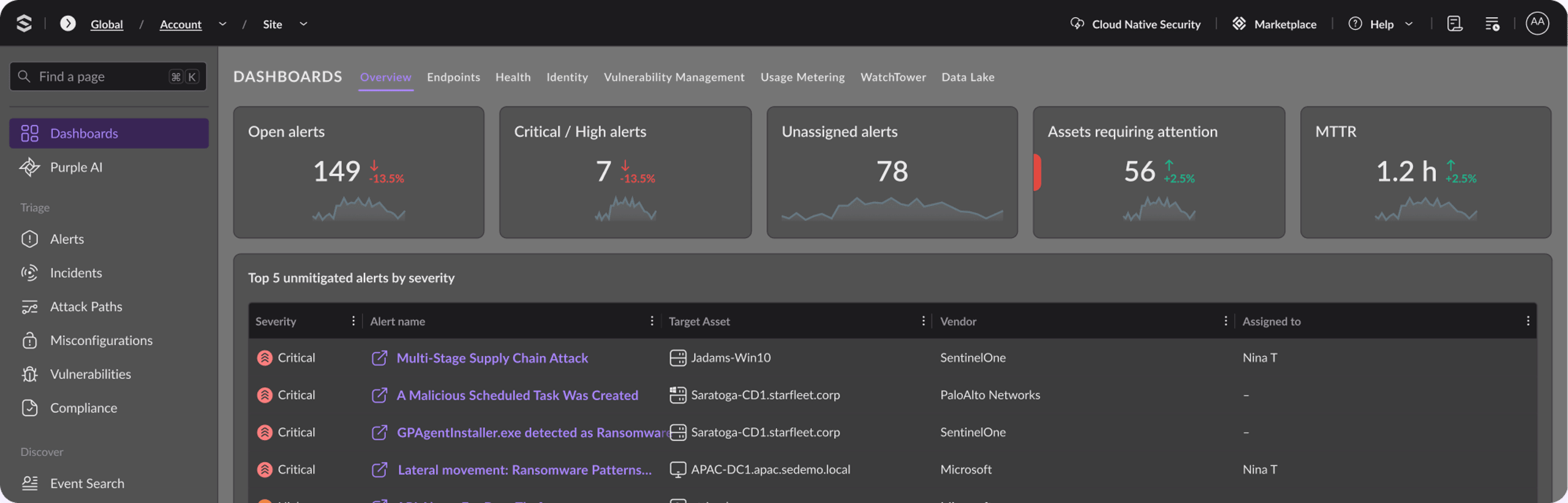
Purple AI serves as your autonomous risk analyst, continuously monitoring AI deployments for unusual behaviors, performance drift, and security anomalies. Unlike periodic assessments that provide point-in-time snapshots, Purple AI delivers ongoing AI risk evaluation that adapts as your models evolve and new threats emerge.
The platform's AI Security Posture Management automatically discovers AI systems across your infrastructure, maintains current inventories, and applies consistent risk scoring based on deployment context and threat exposure. Storyline technology connects risk events across your environment, showing how individual AI security incidents could cascade into broader organizational impact. SentinelOne's Prompt Security can help you find AI risk scores for AI apps and MCP servers. SentinelOne's Prompt Security can help you find AI risk scores for AI apps and MCP servers. Prompt Security's AI Risk Score Assessment Tool can deliver unique AI compliance insights and help businesses make critical business decisions regarding their AI usage. It improves transparency, gives parameter breakdowns, and does certification status checks.
Prompt security secures your AI everywhere. No matter what AI apps you connect to or APIs you integrate, Prompt Security can address key AI risks like shadow IT, prompt injection, sensitive data disclosure, and also shield users against harmful LLM responses. It can apply safeguards to AI agents to ensure safe automation escape. It can also block attempts to override model safeguards or reveal hidden prompts. You can protect your organization from denial of wallet or service attacks and it also detects abnormal AI usage. Prompt Security for AI code assistants can instantly redact and sanitize code. It gives you full visibility and governance and offers broad compatibility with thousands of AI tools and services. For agentic AI, it can govern agentic actions and do hidden activity detection; it can surface shadow MCP servers and do audit logging for better risk management.

The Industry’s Leading AI SIEM
Target threats in real time and streamline day-to-day operations with the world’s most advanced AI SIEM from SentinelOne.
AI cybersecurity capabilities provide comprehensive protection against adversarial attacks while maintaining detailed audit trails necessary for compliance reporting. This approach reduces the manual effort required for AI risk analysis framework implementation while ensuring continuous alignment with risk management objectives.
For organizations implementing AI risk assessment frameworks, SentinelOne's unified approach eliminates the complexity of managing multiple security solutions while providing the automated capabilities necessary for modern artificial intelligence risk assessment programs.
AI Risk Assessment Framework FAQs
Artificial intelligence risk assessment introduces opacity, bias, and autonomy that deterministic IT rarely faces. Traditional risk assessment focuses on known vulnerabilities, while AI security risk assessment must account for probabilistic behaviors and emergent risks.
Run a full artificial intelligence risk assessment annually, but revisit high-impact systems quarterly. Continuous monitoring catches issues between scheduled reviews.
Blend data science, cybersecurity, legal, and ethics expertise. Cross-functional collaboration ensures that the AI security risk assessment covers both technical risks and compliance requirements.
The process involves six steps: identifying and inventorying AI systems, mapping stakeholders and impact areas, cataloging potential risks and threats, analyzing risk likelihood and impact, evaluating risk tolerance and treatment o zptions, and implementing continuous monitoring.
Effective assessments require a cross-functional team that blends data science, cybersecurity, legal, and ethics expertise to cover both technical risks and compliance requirements.
The NIST AI RMF is a voluntary framework, though U.S. agencies increasingly enforce its guidance and it serves as a recognized standard for structuring AI risk evaluation across organizations of any size.
Map your inventory, document data lineage, and embed human oversight now. Establish AI risk analysis frameworks that adapt to new requirements while maintaining operational effectiveness.
Discover More About Data and AI


Ready to Revolutionize Your Security Operations?
Discover how SentinelOne AI SIEM can transform your SOC into an autonomous powerhouse. Contact us today for a personalized demo and see the future of security in action.